
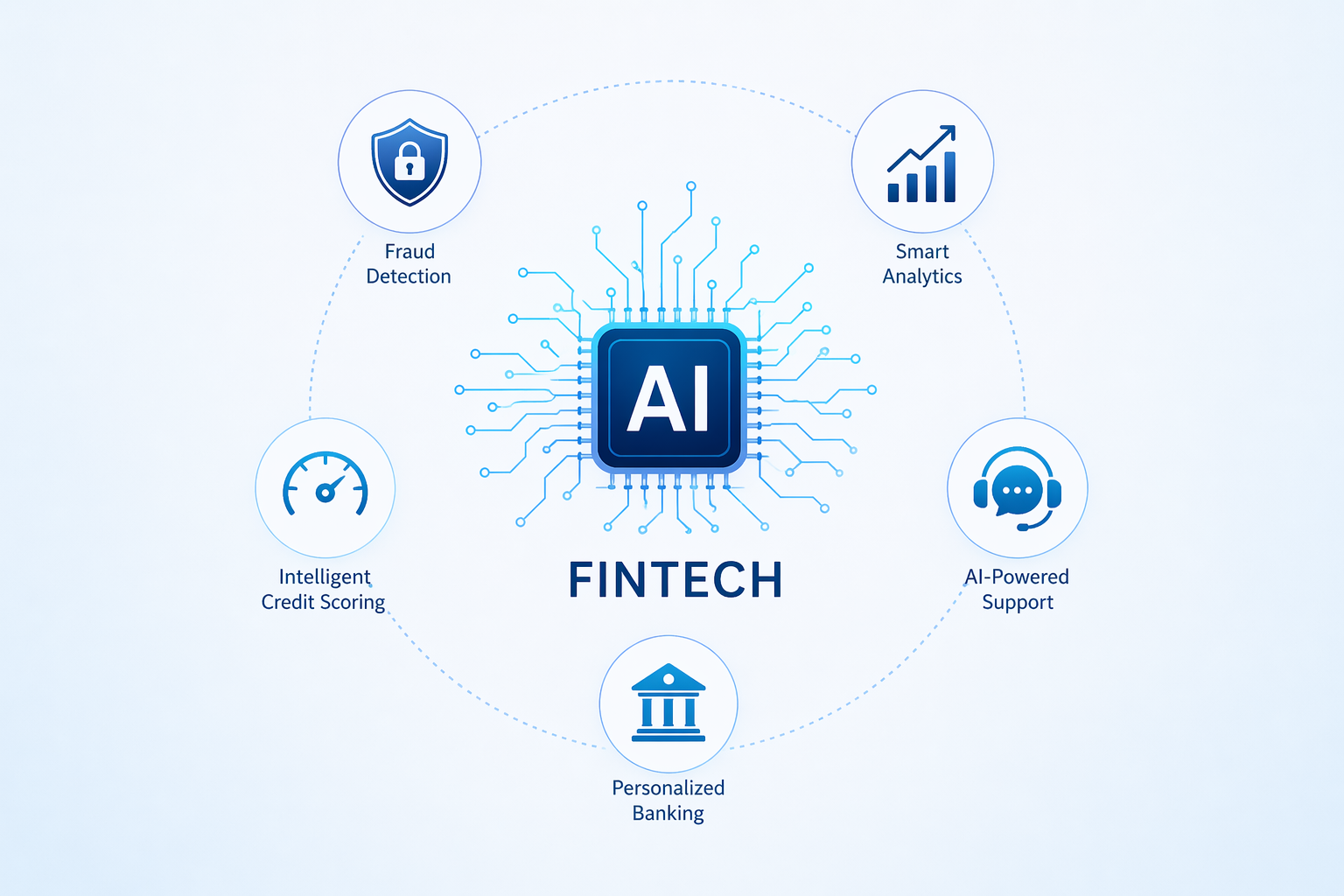
Introduction: Finance Is No Longer Just About Numbers
The financial industry has always been data-rich—but only recently has it become intelligence-driven. Artificial Intelligence (AI) is no longer a futuristic concept in fintech; it’s now the backbone of innovation across payments, lending, insurance, and wealth management.
From fraud detection systems that learn in real time to hyper-personalized banking experiences, AI is reshaping how financial institutions operate, compete, and deliver value.
For fintech companies and enterprises alike, the question is no longer “Should we adopt AI?”—it’s “How fast can we scale it?”
Why AI Is a Game-Changer in Fintech
Traditional financial systems rely heavily on rule-based logic, manual processes, and historical data analysis. AI introduces a paradigm shift by enabling:
- Real-time decision-making
- Predictive analytics
- Automation at scale
- Continuous learning systems
This results in faster operations, reduced costs, and significantly improved customer experiences.
Key Applications of AI in Fintech
1. Fraud Detection and Risk Management
Fraud is one of the most critical challenges in fintech. AI-powered systems can analyze millions of transactions in real time and detect anomalies with high precision.
How AI helps:
- Identifies unusual transaction patterns
- Uses behavioral biometrics for authentication
- Continuously learns from new fraud techniques
Example Use Case:
A payment platform uses machine learning models to flag suspicious transactions instantly, reducing fraud losses by up to 60%.
2. Intelligent Credit Scoring
Traditional credit scoring models often exclude individuals with limited credit history. AI enables more inclusive and accurate assessments.
AI-driven credit scoring uses:
- Alternative data (e.g., mobile usage, transaction behavior)
- Real-time financial activity
- Behavioral patterns
Impact:
- Expands financial access to underbanked populations
- Reduces default risk with better predictive models
3. Personalized Banking Experiences
AI allows fintech companies to deliver hyper-personalized services tailored to individual users.
Capabilities include:
- Smart financial recommendations
- Automated savings plans
- Spending insights and alerts
Example:
AI-driven apps analyze user behavior to suggest budgeting strategies or investment opportunities in real time.
4. Algorithmic Trading and Investment Management
AI is revolutionizing wealth management through data-driven investment strategies.
Key features:
- Predictive market analysis
- Automated portfolio rebalancing
- Sentiment analysis from news and social media
Result:
Faster, more informed investment decisions with reduced human bias.
5. Chatbots and Virtual Assistants
Customer expectations in fintech are higher than ever. AI-powered chatbots provide instant, 24/7 support.
Benefits:
- Reduced operational costs
- Faster query resolution
- Improved customer satisfaction
Advanced capabilities:
- Context-aware conversations
- Voice-based interactions
- Multilingual support
6. Regulatory Compliance (RegTech)
Compliance is complex and resource-intensive. AI simplifies it through automation and intelligent monitoring.
Use cases:
- Automated KYC (Know Your Customer)
- AML (Anti-Money Laundering) detection
- Real-time compliance reporting
Outcome:
Reduced compliance costs and minimized regulatory risks.
Emerging Trends in AI-Powered Fintech
1. Generative AI in Financial Services
Generative AI is being used to:
- Create financial reports
- Automate customer communication
- Generate insights from unstructured data
2. Explainable AI (XAI)
As AI decisions impact financial outcomes, transparency is critical. Explainable AI ensures:
- Better regulatory compliance
- Increased customer trust
- Clear decision-making processes
3. AI + Blockchain Integration
Combining AI with blockchain enhances:
- Fraud prevention
- Smart contract automation
- Secure identity verification
4. Embedded Finance with AI
AI is powering financial services within non-financial platforms:
- AI-driven lending in eCommerce
- Smart payment systems in SaaS platforms
Challenges of Implementing AI in Fintech
Despite its advantages, AI adoption comes with challenges:
Data Privacy and Security
Handling sensitive financial data requires strict compliance with global regulations.
Model Bias and Fairness
AI systems can inherit biases from training data, leading to unfair outcomes.
Integration with Legacy Systems
Many financial institutions still rely on outdated infrastructure, making AI integration complex.
High Initial Investment
Building robust AI systems requires significant investment in technology and talent.
Best Practices for AI Adoption in Fintech
To successfully implement AI, fintech companies should:
- Start with clear use cases (e.g., fraud detection, customer support)
- Invest in high-quality data pipelines
- Ensure regulatory compliance from day one
- Adopt scalable cloud-based AI infrastructure
- Focus on explainability and transparency
The Future of AI in Fintech
AI will continue to evolve from a supporting tool to a core decision-making engine in financial services.
In the next 3–5 years, we can expect:
- Fully autonomous financial platforms
- AI-driven financial advisors (robo-advisors 2.0)
- Real-time global payment intelligence
- Increased financial inclusion through smarter credit systems
Fintech companies that embrace AI early will not just gain a competitive advantage—they will define the future of finance.
Conclusion: AI Is the Competitive Edge Fintech Can’t Ignore
AI is no longer optional in fintech—it’s foundational.
Organizations that leverage AI effectively can:
- Reduce operational costs
- Improve customer experience
- Enhance security and compliance
- Unlock new revenue streams
The real opportunity lies not just in adopting AI, but in integrating it strategically across the entire financial ecosystem.
Call to Action
At Techrays Labs, we help fintech companies design and implement scalable AI solutions—from intelligent automation to advanced analytics.
Looking to integrate AI into your fintech product?
Let’s build smarter, faster, and more secure financial systems together.